
You’ve been in that room before.
Maybe it was a classroom. Maybe it was a conference room in a company where you worked early in your career. Maybe it was a government agency, a nonprofit, a hospital. You were not the one at the front. You were somewhere in the middle — a new hire, a junior team member, a person still figuring out how the place worked.
Someone in a position of authority announced that things were going to change. A new direction. A new framework. A bold commitment to doing things differently. You listened. You may have even believed it.
Then something shifted. Priorities changed. Leadership changed. The funding ran out. The urgency moved on to something else. And the initiative that was going to change everything became something nobody mentioned anymore.
You know exactly what that experience did to your willingness to believe the next announcement.
Your workforce is living that same experience. Right now. In your district.
This Is Human Nature — And Science Can Explain It
This isn’t about attitude. It isn’t about resistance. It is the way human beings are wired when a pattern has let them down.
The brain has a built-in reward signal — neuroscientists call it dopamine — that fires when something new and promising appears. Think of it as the neurological version of hope. It is what makes people lean in, engage, and invest. But that signal only keeps firing if what was promised actually holds. After enough cycles of launch-and-abandon, that signal stops responding. Not because your people stopped caring about students. Because they showed up fully for the last initiative, followed through on what was asked of them, got their hopes up — and walked away disappointed when nothing held.
What you experience as resistance to change is often the story of people who believed before, gave everything they had, and discovered it wasn’t enough to make a difference.
That is human nature. And once you understand it, you discover something important: the path through it is not more enthusiasm. It is a different kind of evidence.
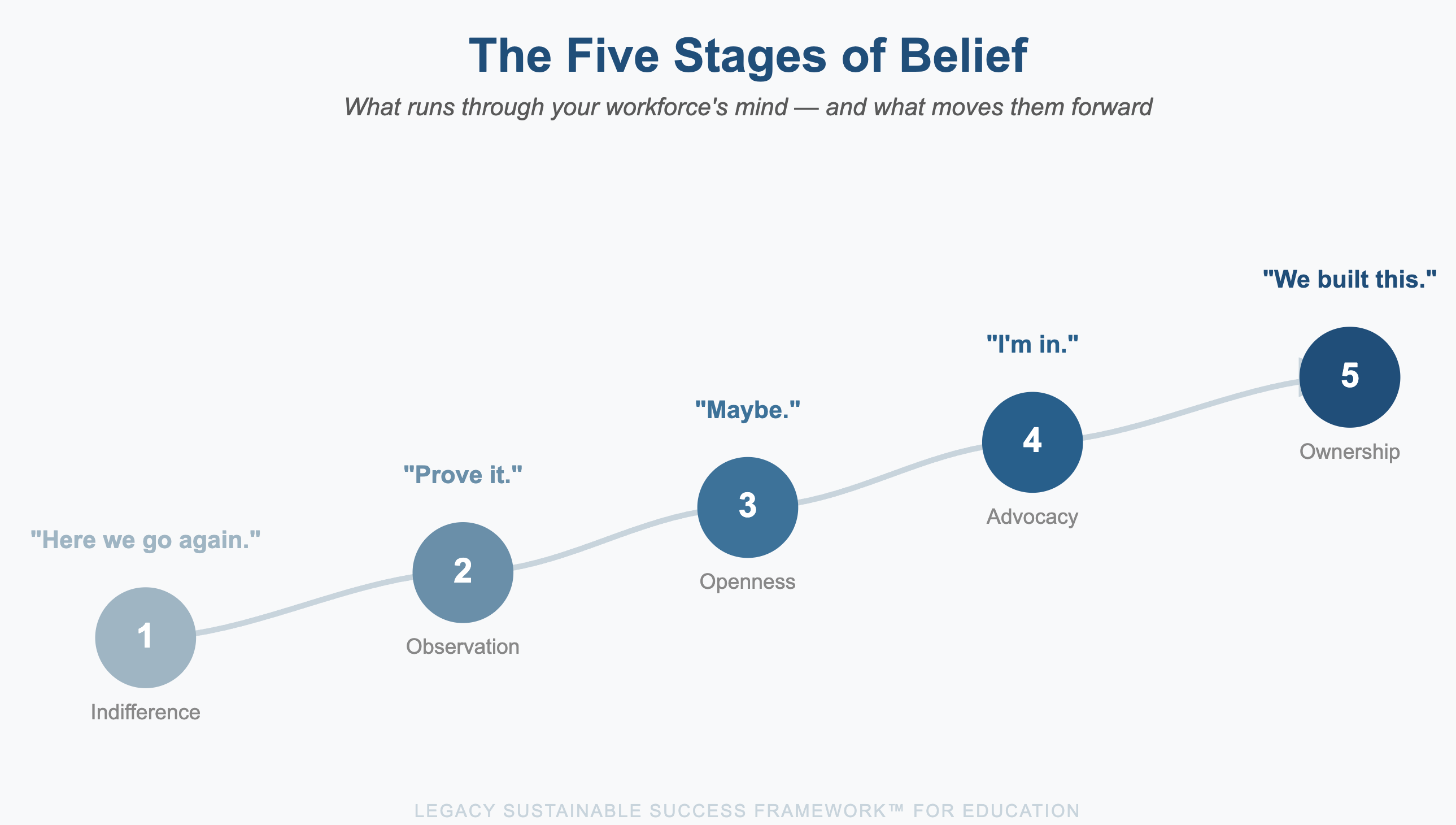
The Five Stages — And What Each One Requires
The workforce does not move from skepticism to belief in a single moment. They move through stages. Each stage is defined by what is running through their heads every time leadership speaks.
“Here we go again.”
This is the starting point for districts that have been through a change cycle that started strong and stopped before it had a chance to prove itself — initiatives that were announced, invested in, and then set aside when leadership changed, funding dried up, or the next priority arrived. If your district has that history, this is where your workforce lives.
It is not anger. It is not even active resistance. It is the professional version of going through the motions — sitting through the presentation, completing the survey, and internally filing the whole thing under we will see how long this one lasts.
The workforce at this stage has not made a decision against you. They have simply learned not to make a decision at all until they see something different. No announcement accelerates that. Only time and evidence do.
“Prove it.”
Something has shifted. The message has held longer than usual. Leadership has followed through on something — even something small. The workforce has not committed to anything, but they have moved from indifference to attention.
This is the most important stage in the sequence. And it is the one where most change efforts fall apart.
At “Prove it,” people start watching everything. Every meeting, every board decision, every conversation in the hallway is being measured for consistency. Not because they are looking for a reason to object — because they are looking for a reason to believe. And the thing that stops them is always the same: the cracks.
The superintendent says one thing. A principal says something slightly different. The board approves a budget that contradicts the stated priority. The message is confident in the large meeting and uncertain in the smaller one. A leader who championed the direction stops talking about it.
The workforce catches all of it. Every single time. And each inconsistency confirms what they already suspected.
What moves people out of “Prove it” is not a better speech. It is every leader — board, superintendent, cabinet, principals — delivering the same message, at every meeting, in every conversation, without deviation. Not scripted. Aligned. There is a critical difference between the two. Scripted collapses under pressure. Alignment holds because every person at the leadership table has genuinely internalized the direction and understands why it matters.
When you add to that a purpose statement that is unambiguously clear — not a committee document, but a declaration of what this district exists to do — you give the workforce something real to test decisions against. That is what begins to move the needle.
“Maybe.”
This is the first real opening. The workforce has not committed. But they have stopped dismissing it. Something has been consistent long enough that the brain begins — carefully, reluctantly — to update its model.
This stage is the one you have to protect. One high-profile inconsistency sends people back to “Prove it” immediately. What sustains “Maybe” is continued alignment from every voice in leadership — and a purpose clear enough that people can see it at work in daily decisions, not just in presentations.
Once you get to “Maybe,” you realize how much ground has already been covered. The work is not to push harder. It is to hold the line.
“I’m in.”
The champions surface here. Not because leadership recruited them — because they have been watching, and they have decided the evidence is sufficient. They begin to move without being asked. They bring colleagues along. They make the case in the places where leadership never goes — the faculty lounge, the conversation after the meeting ends, the exchange between principals on a Friday afternoon.
This is where early adopters become the recruiters that no hiring process can create. Your job at this stage is to recognize them, honor them, and make sure they never regret stepping forward. When you do that, you discover something powerful: the conversion of skeptics happens not through leadership persuasion but through peer credibility.
Hold the alignment. Keep the purpose visible. Do not make the champions look naive for believing.
“We built this.”
The direction is no longer a leadership initiative. It belongs to the culture. The workforce has moved from observers of change to owners of it. Once you reach this stage, you begin to see the unlimited potential of what a fully aligned district can accomplish — and what generational academic excellence actually looks like in practice.
But this stage carries its own vulnerability that most districts never prepare for.
In large urban districts, currently serving superintendents average fewer than three years in the role. When a leader leaves, everything built around their personal presence — their relationships, their credibility, their particular way of holding the culture together — is at risk. A workforce that reached “We built this” under one leader can find itself back at “Here we go again” under the next. Not because the new leader is wrong. Because the work lived in a person rather than a structure.
The districts that hold this stage are the ones that built the framework into the institution itself — into playbooks that capture how decisions get made, into scorecards that track what actually matters, into a purpose statement embedded deeply enough to survive the next board election and the one after that. When you build it that way, the work does not leave when the leader does. The next superintendent inherits something to lead — not a blank slate to restart.
The Question Worth Sitting With
People do to others what they do not want done to themselves. Every leader who has ever started something and moved on before it had a chance to prove itself has left a mark on someone else’s willingness to believe the next thing.
That is not an indictment. It is human nature, and it runs through every organization at every level.
The question is what you do when you realize it. When you discover that the path from “here we go again” to “we built this” is not about a better launch strategy — it is about alignment deep enough that the workforce stops looking for cracks, because there are none to find.
That is what a LEGACY district is built to be. And it is replicable.
To explore what building toward generational academic excellence looks like in your district, reach out: DLRogers@CFPInnovation.com — subject: LEGACY Roadmap.